


For many commercial businesses, capacity charges are one of the fastest-growing components of an electricity bill and among the least understood.
Unlike energy charges, which pay for the electricity you consume, capacity charges pay for something different: ensuring there is enough electricity generation available when the grid experiences its highest levels of demand.
Here's the core concept: on the hottest days of the year, millions of homes and businesses run AC at the same time, causing electricity demand to spike. Grid operators (the organizations responsible for keeping the lights on) have to ensure there is enough generation capacity available to meet that demand, even if they’re only needed during these rare peak events.
Building, maintaining, and compensating those resources costs money, and those costs are ultimately shared by electricity customers.
How Are Capacity Costs Determined?
Regional transmission organizations (RTOs) such as PJM, ISO New England (ISO-NE), and the New York ISO (NYISO) hold forward capacity auctions several years before electricity is delivered.
In PJM's most recent capacity auction for the 2028/29 delivery year, the market once again cleared at the price cap after procuring less capacity than the region's reliability target—the third consecutive auction to do so.
Learn more with our full breakdown of the PJM 2028/29 Capacity Auction Results and What They Mean for Commercial Energy Buyers.
Two things drive your capacity costs: the auction price and your own coincident peak usage. After the auctions run, the total cost is allocated across electricity customers, based on Peak Load Contribution (PLC), which reflects how much electricity each customer uses during the annual system peak hours. In other words, the more electricity your facility is drawing from the grid during those critical peak hours, the larger your share of those costs.
What Makes an Hour a System Peak Hour?
The challenge is that system peak hours aren’t announced in advance. Instead, they are identified after the fact based on when energy demand actually hits its highest point. That unpredictability is part of what makes them hard to manage.
One common misconception is that every hot afternoon matters equally. In reality, only the official coincident peak hours are used to determine your capacity tag. See below for the actual peak hours in PJM in 2025.
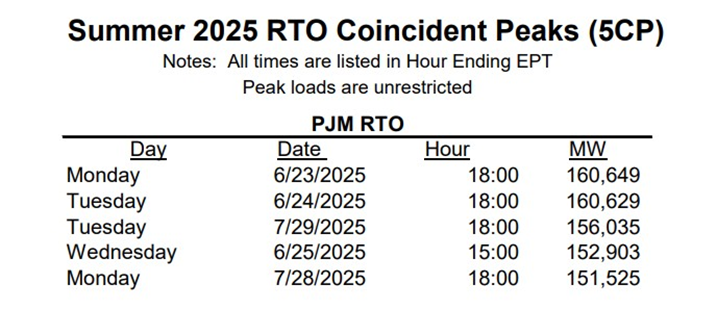
Source: Summer 2025 RTO Coincident Peaks (5CP).
Note: 15:00 (3:00 PM) and 18:00 (6:00 PM)
What Is a Capacity Tag?
Your facility’s electricity demand during those critical peak hours becomes your capacity tag. Think of it as your facility's share of the regional grid’s capacity requirement.
Different regions use different terminology:
| Market | Capacity Tag | Based on Demand During |
| PJM | Peak Load Contribution (PLC) | 5 annual coincident peak hours |
| NYISO | Installed Capacity (ICAP) Tag | 1 annual coincident peak hour |
| ISO-NE | Capacity Load Obligation (often referred to as Capacity Tag by suppliers) | 1 annual coincident peak hour |
Once established, the capacity tag is used to calculate your monthly capacity charges for the next delivery year. It shows up on your bill every single month as a recurring cost tied to what happened during a few hours the previous year.
Why Should Commercial Businesses Care?
Capacity prices in PJM have risen dramatically in recent years. For the current 2026/27 delivery year, the PJM capacity auction cleared at $329/MW-day—nearly 11 times higher than the previous year's auction.
Beginning June 1, 2026, these elevated capacity costs have already started to flow through to commercial electricity bills. For many commercial and industrial customers, that translates to a 15-20% increase in annual electricity costs, even if their energy usage and capacity tag remain unchanged.
While businesses can't control the market price of capacity, they can influence how much they pay through managing their capacity tag.
What You Can Do About It
Reducing demand during system peak hours is a meaningful lever to lower your future capacity tag, producing savings that last an entire delivery year. For facilities with large cooling loads or continuous operations, those savings can be substantial.
Interested in learning how? Read about how commercial facilities use procurement strategies, operational changes, and onsite generation to lower their capacity tag in our guide: Commercial Electricity Costs Are Rising: How Facility Operators Can Manage Long-Term Cost Exposure.
.png?width=720&name=Untitled%20design%20(26).png)
.png?width=720&name=New%20Stock%20Image%20Searching%20(20).png)