
If you've been looking at your facility's electric bill and wondering why it keeps climbing even though your usage hasn't changed dramatically, you're not alone.
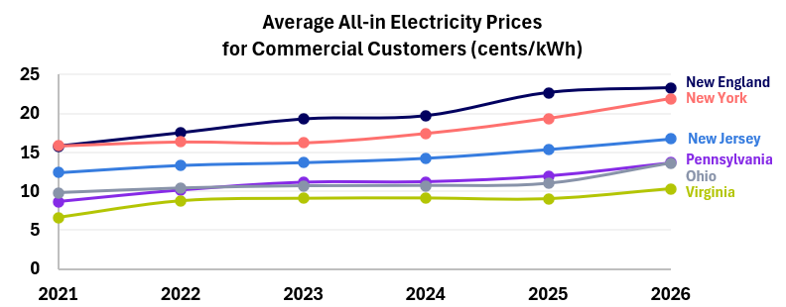
Commercial electricity rates in the Northeast states have increased 35-60% since 2021 (Catalyst Power analysis, based on EIA monthly data, Form EIA-861M), driven by rising wholesale energy prices, growing reliability costs, and investments in grid infrastructure. For many businesses, these increases have occurred even when electricity usage has remained relatively stable.
For facilities that rely heavily on electricity — including manufacturing, hotels, senior living communities, multifamily properties, and more — the impact goes beyond a monthly utility bill. Higher energy costs affect operating budgets, financial planning, and long-term business competitiveness.
Why Are Commercial Electricity Costs Increasing?
Commercial electricity costs are rising because the U.S. power system is entering a period of unprecedented change.
After decades of relatively flat electricity demand, the U.S. power grid has entered a new era of growth. Rising demand from data centers, reshoring of domestic manufacturing, and electrification of transportation and heating are placing new pressures on an already aging grid. Meanwhile, the retirement of legacy resources, including coal-fired generation, has accelerated faster than the deployment of replacement capacity, creating growing challenges around reliability, grid resilience, and meeting future energy needs.
Combined with fuel price fluctuations, extreme weather events, and global events that affect fuel markets and supply chains, these dynamics are driving cost increases across every part of the electricity system — from generating electricity to delivering it across the grid and maintaining reliable service during periods of peak demand.
What's Included in Your Commercial Electricity Bill
To understand why business electricity costs are rising, it is important to look beyond the total amount of energy a facility consumes. Changes in wholesale energy markets, grid investments, capacity requirements, and reliability programs all influence the charges that appear on a commercial electricity bill.
Here are the key components of what you’re paying for:
| Component | What it Covers | What's Driving Costs |
| Energy Supply |
Cost to produce electricity from available generation resources |
Wholesale energy prices are influenced by fuel prices, weather, generator availability, and real-time supply-demand conditions |
| Transmission & Distribution |
Cost to transmit and distribute electricity through the grid to businesses |
Investor-owned utilities incentivized to earn their regulated rate of return are investing billions in infrastructure upgrades to modernize aging systems |
| Capacity & Grid Reliability |
Cost of ensuring enough resources are available during peak demand and extreme conditions |
Capacity market prices and reliability costs are increasing as the grid requires additional resources to maintain reliability |
| Energy Programs & Policy Goals |
Charges supporting energy initiatives such as renewable energy, efficiency programs, and other state/regional priorities |
State and regional policies (like Renewable Portfolio Standards) can create additional charges to end-use customers |
Why It Matters Now
- Growing electricity demand: U.S. electricity demand is entering its strongest sustained growth period in decades, with the U.S. Energy Information Administration forecasting demand to rise 1% in 2026 and 3% in 2027, driven by AI, data centers, domestic manufacturing, and electrification.
- Higher capacity costs: Capacity prices have increased sharply in several regional markets as demand forecasts rise, older generation retires, and grid operators procure additional resources to maintain reliability. In PJM, the systemwide capacity price jumped from $28.92/MW-day for 2024/2025 to $325/MW-day for 2028/2029.
- Grid modernization: Utilities continue investing billions of dollars in transmission, distribution, storm hardening, and infrastructure modernization, with many seeking cost recovery through rate cases. Recent analyses show investor-owned utilities have raised five-year capital spending plans by about 21%, to roughly $1.4 trillion through 2030.
- Natural gas market volatility: Because natural gas remains the marginal fuel source in many wholesale electricity markets, changes in gas prices continue to influence electricity prices.
How Peak Demand Periods Drive Up Electricity Costs
For many industrial and commercial customers, business electricity costs are determined by more than how much energy they consume. When that electricity is used can also significantly impact annual costs.
Electricity systems must always maintain enough generation and grid capacity to meet the highest levels of demand. To ensure reliability, regional grid operators such as ISO-NE, NYISO, and PJM identify periods when electricity demand across the grid reaches its highest levels. They then allocate a portion of the cost of maintaining that generation capacity to customers based on how much electricity each facility used during those periods—a key driver behind rising commercial electricity costs.
In many deregulated markets, your facility's contribution during these system peaks is measured through a peak load contribution (PLC) or capacity tag. While each market uses its own methodology, they all follow the same principle: facilities that consume more electricity during periods of peak system demand are generally assigned a larger share of future capacity-related costs.
The result is that a relatively small number of high-demand hours can influence electricity costs for the next twelve months, regardless of which electricity supplier you're working with.
Understanding when your facility reaches its highest demand and reducing load during periods when the grid is approaching its annual peak can create meaningful savings without reducing overall energy consumption.
How to Manage and Reduce Commercial Electricity Costs
Businesses cannot control every factor that influences energy prices. But they can control how they understand, plan for, and manage their energy exposure.
The first step is to develop a clear picture of where electricity costs come from. That includes understanding which charges are fixed, which are market-driven, and which can be influenced through operational changes.
1. Understand Your Electricity Bill
Before evaluating solutions, understand what you're paying for.
Key questions include:
- Which components make up the largest portion of your electricity bill?
- How much of your cost comes from energy supply versus capacity and delivery charges?
- Are certain charges driven by market conditions or your facility's operating profile?
- Which costs can your business actually influence?
Understanding your bill provides the foundation for identifying opportunities for significant savings.
2. Understand Your Energy Profile
Once you understand your bill, evaluate how your facility uses its electricity service. There is a wealth of free resources available to commercial customers. Take advantage of energy audits, incentive programs, and independent energy advisors to better understand your facility's energy usage and identify opportunities to reduce long-term business rates.
Important questions include:
- When does your facility reach its highest electricity demand?
- How exposed are you to wholesale market volatility or capacity costs?
- Are there opportunities to shift load, improve efficiency, or reduce peak demand?
- Would onsite generation or other distributed energy resources improve cost control?
Gathering multiple perspectives and recommendations can help you make the most informed, cost-effective decision for your business.
3. Build a Long-Term Energy Strategy
Energy decisions are often made reactively: when a contract term expires, utility rates increase, or operating needs change.
A proactive approach allows businesses to evaluate opportunities before they become urgent.
An effective energy roadmap can help organizations:
- Understand current costs and risks
- Improve budget predictability
- Reduce exposure to future electricity price increases
- Evaluate procurement strategies, demand management, and onsite energy resources
- Compare fixed rate plans against variable pricing to align contract structure with risk tolerance
- Align the right energy plans with future business plans
The businesses best positioned for a changing energy landscape are not necessarily those that can predict every market shift.
They are the ones that understand their position and have a plan.
Get Started: Build a More Predictable Energy Strategy
The energy landscape is becoming more complex, but businesses don't have to navigate it alone.
While no organization can control wholesale markets or utility rate increases, every business can better understand its electricity costs, reduce unnecessary exposure, and develop a strategy aligned with its operational and financial goals.
At Catalyst Power, we help commercial and industrial businesses evaluate their energy position, identify opportunities to reduce long-term cost exposure, and implement solutions across energy procurement and onsite generation. Whether your goal is lower costs, greater budget certainty, or improved long-term resilience, we help you build an energy strategy designed for today's evolving electricity market.
Contact us today to start building a more predictable and resilient energy strategy.
.png?width=720&name=Untitled%20design%20(26).png)