

Operators across the country are grappling with the same uncomfortable reality: the fundamentals of running a hotel have gotten structurally harder, and the margin for error has shrunk.
In a market of flat Revenue Per Available Room (RevPAR) growth and compressing margins, cost control is no longer optional, but essential. Labor is more expensive. Debt is more expensive. Renovations are more expensive. So, even if your occupancy looks healthy, you're likely to keep less of every dollar you bring in than you were before.
That tension, between healthy top lines and shrinking margins, is the undercurrent of nearly every conversation with leaders across the industry. It's why the operators who will come out ahead aren't just focused on driving revenue, they're being ruthlessly disciplined about costs. Energy is one of the biggest opportunities most properties are leaving on the table, and it's one you can act on right now.
The Cost Squeeze Is Real, and It's Not Letting Up
The tightening margins aren’t a temporary blip; it's the new operating reality for much of the industry. When you can't grow your way out of rising costs, you have to cut your way through them.
The challenge is that the biggest cost drivers are largely outside an operator’s control. Labor costs continue to climb as wage competition remains fierce and staffing stays tight. Construction and renovation costs have risen 3-5% over the last 18 months, making capital projects more expensive to execute. And with interest rates still elevated, debt service continues to pressure operating performance across the board.
That leaves operators with a clear mandate: scrutinize every controllable cost line and identify levers that actually move the needle. And one of the most significant, most recurring, and most actionable of those lines is energy. Unlike labor agreements or loan terms, energy costs can be addressed now without waiting for market conditions to shift in your favor.
But there's another layer to this challenge: even when operators identify opportunities to reduce costs, many don't have unlimited capital to pursue them.
See how we reduced energy costs by 15% for a hotel in Massachusetts:
-3.png?width=940&height=630&name=Untitled%20design%20(30)-3.png)
Capital Is Scarce. Spend It Where It Counts.
At the same time, as margins tighten, the industry is renovating and repositioning at scale. Guest expectations have evolved, competitive sets are being refreshed, and brand standards are pushing properties toward meaningful upgrades.
That means capital allocation decisions have become increasingly strategic. Every dollar deployed has to compete against projects tied directly to guest experience and revenue generation.
The consensus across the industry is clear: prioritize investments that guests can see and feel. Projects like lobby refreshes, room upgrades, F&B concepts, wellness amenities, a great kids’ club, and technology enhancements help drive ADR, occupancy, and brand competitiveness.
As a result, large back-of-house infrastructure projects often get deprioritized, even when they could materially improve operating performance over time.
That dynamic creates an important gap in the market: hotel operators need solutions that reduce operating costs without forcing them to divert capital away from guest-facing priorities. And that’s exactly where energy infrastructure, when structured correctly, becomes strategically interesting.
CHP as a Solution to Both Problems
One of the most compelling options available to hotel operators today is Combined Heat and Power (CHP), also called cogeneration. While technologies like solar and battery storage can play an important role, CHP is uniquely suited to hospitality properties because it simultaneously addresses both continuous electrical demand and large thermal loads.
Hotels simultaneously run HVAC systems around the clock, heating pools, supporting commercial kitchens, producing hot water, and operating laundry facilities, all while purchasing electricity from the grid and separately paying for fuel used for heating. In most properties, those systems operate independently, creating two major utility expenses and significant built-in inefficiencies.
CHP changes that equation.
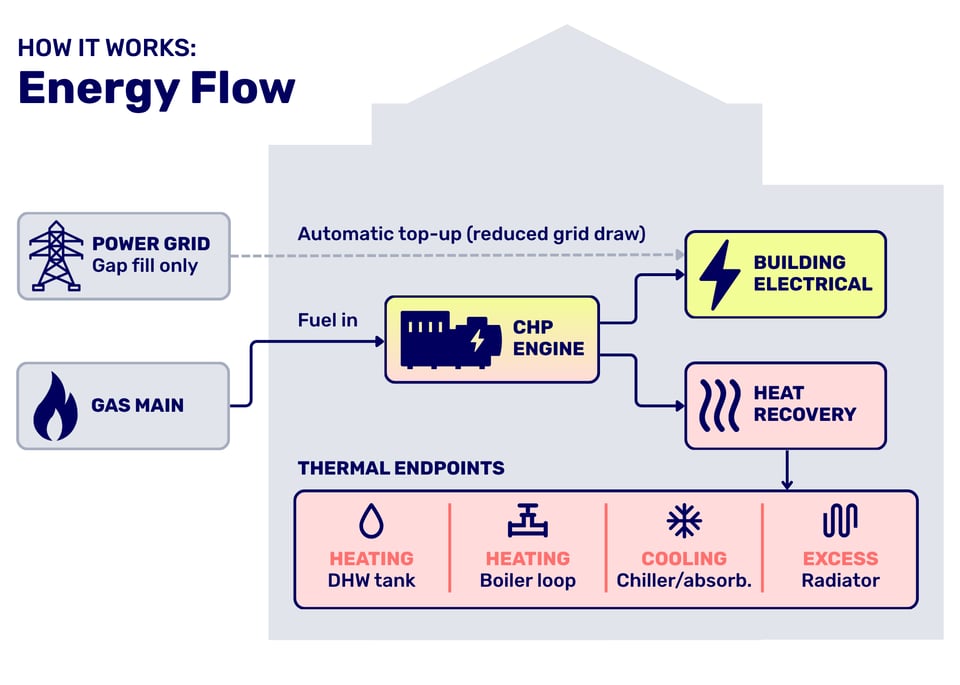 Instead of purchasing electricity and heat separately, a CHP system generates electricity onsite while capturing the waste heat produced during generation and repurposing it for heating or cooling thermal loads throughout the property. The result is a single integrated system that can simultaneously reduce electric costs and heating/cooling costs.
Critically, CHP with Catalyst Power requires no upfront capital investment. That means your capex budget stays focused on the front-of-house renovations that drive revenue and elevate the guest experience, while your operating costs come down without a dollar of capital deployed for a back-of-house project. In a market where every capital decision is under scrutiny, that flexibility matters.
You Don't Have to Wait for a Renovation to Act
One of the most persistent misconceptions in hotel operations is that energy improvements have to be tied to a renovation cycle or a major capital project. They don't.
Reducing what you pay for energy can start right now. Retail electricity and gas are a low-barrier, immediately accessible way to take control of your power costs. Most hotel operators are overpaying for energy without realizing it – understandably, because energy markets are complex, rate structures are constantly evolving, and energy procurement rarely gets the same level of strategic attention as revenue management or staffing.
A straightforward rate review can quickly identify savings, with no disruption to operations. No renovation cycle required. No capital at risk. Just a smarter approach to a cost you're already paying.
The Bottom Line
The operators who thrive in this environment will treat every cost line as a strategic lever. Energy is one of the few line items you can actually control, and unlike labor contracts or interest rates, you don't have to wait for market conditions to change to act.
Whether you're mid-renovation, planning your next capital cycle, or simply looking for ways to tighten operations without disrupting the guest experience, attainable solutions like CHP and effective electricity and gas procurement strategies offer a path to immediate and long-term savings without upfront capital requirements.
Contact our Energy Experts to learn more about CHP and custom electricity options for your property.
.png?width=720&name=image%20(33).png)
.jpg?width=720&name=New%20Stock%20Image%20Searching%20(14).jpg)