

For decades, facility operators have treated energy as a fixed operating expense. Today, that assumption is becoming increasingly risky. Between volatile utility pricing, aging infrastructure, and growing pressure for grid reliability and sustainability, commercial and industrial operators are rethinking how energy is sourced and managed.
Combined heat and power (CHP) is emerging as a compelling answer, capturing heat that would otherwise be lost during onsite energy production and putting it to work. It's not a new technology, but the way businesses can access it today is, and a growing number of Northeast businesses are taking notice.
In this post, we'll break down what CHP is, why now is a smart time to consider it, and which industries tend to see the biggest results.
What Is CHP?
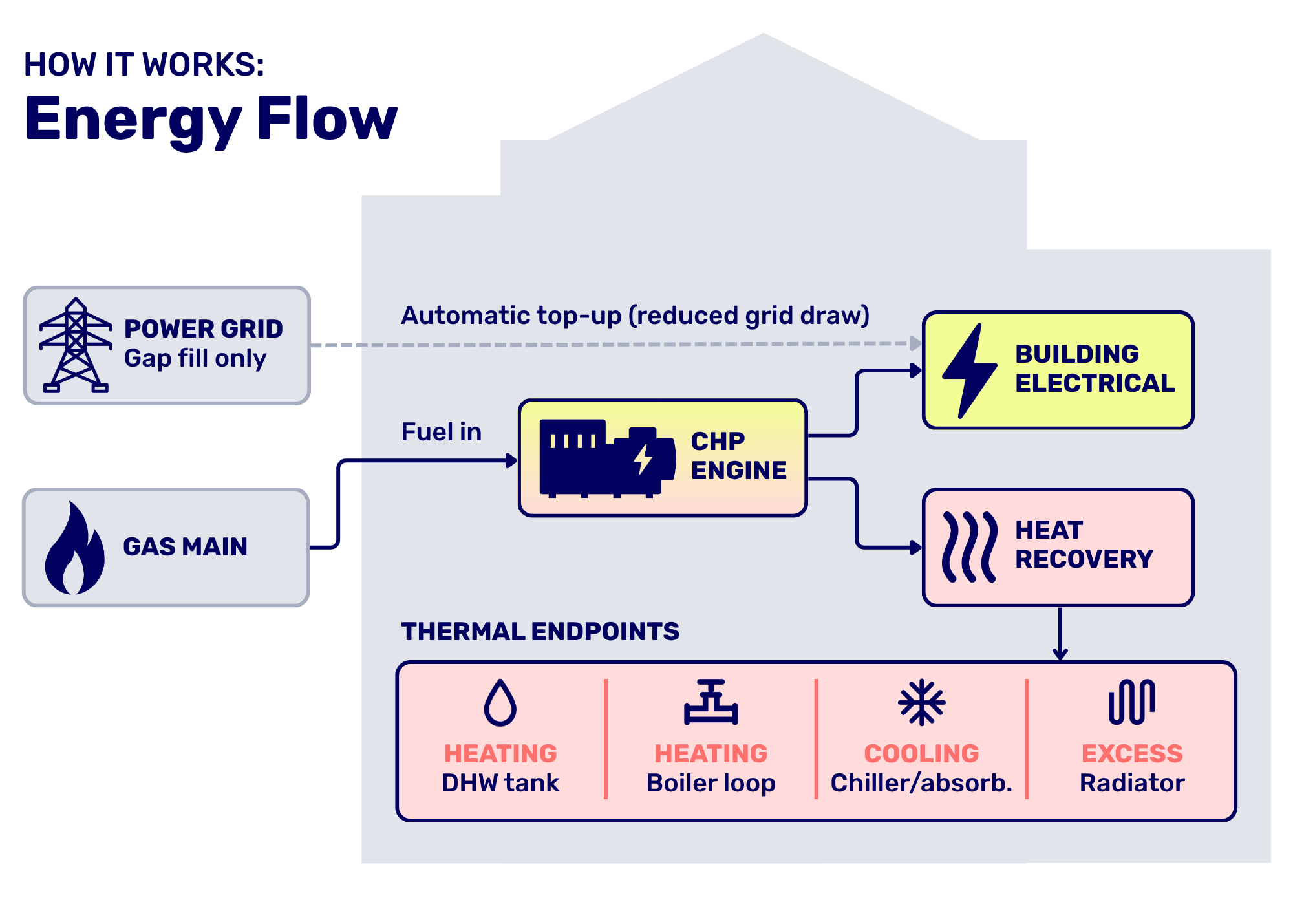
At its core, combined heat and power (CHP) is exactly what it sounds like—one system that produces two usable outputs: electricity and heat.
Here's how it works: a CHP system generates power onsite, just like a traditional generator. But instead of letting the heat produced during that process escape into the air, the system captures it and uses it for space heating, hot water, or even cooling. That recovered energy is what makes CHP fundamentally different from conventional power generation.
The result is a system that can reach up to 90% overall efficiency, compared to roughly 50% for conventional grid power combined with a natural-gas-fired boiler system.
It's also worth noting that CHP isn't experimental technology. It runs on existing supply chains and infrastructure, primarily natural gas. However, systems can also be compatible with renewable natural gas (RNG), biogas, or hydrogen as those fuel sources become more available.
Why Are We Talking About CHP Now?
The short answer: because the economics are stronger than ever, and so is the path to entry.
Electricity prices in the Northeast are among the highest in the country and continue to rise. According to the U.S. Energy Information Administration, the average commercial electricity rate in the New England region was 74% higher than the national average, while the Mid-Atlantic's was 35% higher, as of March 2026. For businesses that depend entirely on the grid, that means exposure to rate swings they have little ability to predict or control.
That's not a short-term trend. It's a structural reality driven by aging infrastructure, constrained fuel supply, and rising demand, and it's pushing more commercial and industrial operators to look for alternatives.
Historically, the biggest barrier to CHP adoption has been the upfront cost of equipment and installation. Today, that barrier is increasingly being addressed by more flexible financing models that eliminate the need for upfront capital investment. At Catalyst Power, for example, we offer a financed solution in which we own, install, and operate the system. You buy the energy it produces at a discount to your utility rate, with no capital outlay required. For many facilities, that means accessing meaningful energy savings from day one.
The result is that more facilities are adopting CHP than ever before, across a wider range of industries and building types.
Industries Where CHP Makes Sense
CHP systems work best where there's a consistent, simultaneous need for both electricity and heat. These are the industries where that profile shows up most reliably, and where the operational and financial impacts are often easiest to measure.
Campuses & Universities - Large campuses with centralized infrastructure are well-suited to CHP. Energy savings can help institutions stabilize operating budgets, support decarbonization goals, and reinvest in student facilities, research programs, and campus improvements.
Hospitality (Hotels) - Hotels have year-round heating, cooling, and hot water loads that support guest comfort expectations year-round. CHP can reduce utility spend, allowing owners to redirect savings toward front-of-house renovations, guest amenities, and property upgrades that drive occupancy, RevPAR, and guest satisfaction.
-3.png?width=940&height=630&name=Untitled%20design%20(30)-3.png)
Manufacturing & Industrial - Energy-intensive operations with steady base loads are a natural fit for CHP. For manufacturers, lowering the cost of electricity and thermal energy can reduce per-unit production costs, protect margins, and support operational continuity without disrupting production schedules.
Multifamily Residential - Large residential buildings run hot water and HVAC systems around the clock, creating exactly the kind of steady, predictable energy demand that a CHP system is designed for. For building owners facing rising utility costs and margin pressure, CHP can help lower operating expenses, stabilize utility budgets, and preserve NOI.
Senior Housing & Skilled Nursing - Senior housing and skilled nursing facilities operate 24/7 and cannot afford interruptions to power, heating, or hot water. Maintaining resident comfort and meeting regulatory temperature requirements are paramount. CHP helps operators control escalating energy costs that directly impact care budgets.
Is CHP Right for Your Building?
CHP isn't the right fit for every facility. But for many industrial and commercial buildings, it can meaningfully reduce operating costs, improve efficiency, and create a more strategic approach to energy infrastructure.
The strongest candidates tend to share a few common traits: consistent, simultaneous demand for heat and power, high utility bills, aging boiler or HVAC equipment, and available mechanical space for installation.
If that sounds like your building, it's worth a conversation. Download our CHP Fact Sheet to dig deeper or skip straight to the source and talk to one of our Energy Experts at Catalyst Power. There's no commitment required, just a straightforward conversation about whether CHP makes sense for your facility.
.jpg?width=720&name=New%20Stock%20Image%20Searching%20(43).jpg)
.jpg?width=720&name=New%20Stock%20Image%20Searching%20(40).jpg)
.jpg?width=720&name=New%20Stock%20Image%20Searching%20(37).jpg)